
.png "PET Cyclotron")
Positron Emission Tomography (PET) Cyclotron
Positron Emission Tomography (PET) is an imaging technology employing radioisotopes with short lifetimes. These radioisotopes are generated through the use of a particle accelerator like a cyclotron. In this process, high-speed particles are accelerated and directed toward a target substance, triggering a nuclear reaction that yields the desired radioisotope.
The radioisotope substance is then transferred into a Hot lab room, where the production of the PET drug occurs through chemical reactions within a Synthesizer, located in a hot cell. The quality of the PET drug is tested through rigorous quality checks (QC). After passing QC, the PET drug is dispensed to a vial or a syringe within the Hot lab, and transported to an injection room. After injection to the patient, the patient rests for about an hour until the PET drug spreads throughout the body. The patient then undergoes PET-CT imaging with a PET-CT scanner.
The radioisotope substance is then transferred into a Hot lab room, where the production of the PET drug occurs through chemical reactions within a Synthesizer, located in a hot cell. The quality of the PET drug is tested through rigorous quality checks (QC). After passing QC, the PET drug is dispensed to a vial or a syringe within the Hot lab, and transported to an injection room. After injection to the patient, the patient rests for about an hour until the PET drug spreads throughout the body. The patient then undergoes PET-CT imaging with a PET-CT scanner.

CYPRIS HM-12

- Can accelerate 2 types of particles (Proton 12 MeV; Deuteron 6 MeV)
- Flexible target configuration with max. 8 targets (4 targets x 2 ports). Simultaneous irradiation is available.
- High production capacity with high current beam and targets for clinical and R&D
- Significant space saving with self-shielding (option)
- Easy, safe, and less radiation exposure for maintenance and service with vertical beam orientation
- Capacity for metal and halogen isotope production (68Ga, 64Cu, 89Zr, 123I, 124I, etc)
CYPRIS HM-12SPC (Shielded-Proton-Compact)
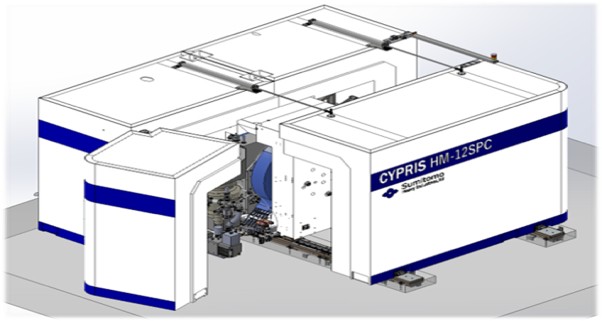
- Reliable, High Performance, and Cost Effective: Proton dedicated (12 MeV)
- Single target port (Max. 4 targets)
- High production capacity with high current beam and targets for clinical and R&D
- Smaller footprint: newly designed self-shielding
- Easy, safe, and less radiation exposure for maintenance and service with vertical beam orientation, shielding door to maintain major parts other than target port, vertical acceleration plane
- Capacity for metal and halogen isotope production (68Ga, 64Cu, 89Zr, 123I, 124I, etc), Liquid transfer type target (Option)
CYPRIS HM-18HC

- Reliable, High Performance, and Cost Effective: Proton dedicated (18 MeV, ultra high current 400 uA)
- Large 18F production yield
- Dual port irradiation available
- High production capacity with high current beam and targets for clinical and R&D
- Significant space saving with self-shielding (option)
- Easy, safe, and less radiation exposure for maintenance and service
- Capacity for metal and halogen isotope production (68Ga, 64Cu, 89Zr, 123I, 124I, etc)

CYPRIS HM-20
- Can accelerate 2 types of particles (Proton 20 MeV; Deuteron 10 MeV)
- Flexible target configuration with a maximum of 8 targets (4 targets x 2 ports). Simultaneous irradiation is available.
- Excellent production capacity with high current beam and targets for clinical, R&D, and delivery applications
- Significant space saving with self-shielding (option)
- Easy, safe, and reduced radiation exposure for maintenance and service with vertical beam orientation
- Capacity for metal and halogen isotope production (68Ga, 64Cu, 89Zr, 123I, 124I, etc)


CYPRIS HM-30
CYPRIS MP-30 (Multiple Particles)
- Reliable, High Performance, and Cost Effective: Proton dedicated (30 MeV, ultra high current 1000 uA)
- At the moment, dedicated to therapy (BNCT)
- Can accelerate 3 types of particles: Proton 15-30 MeV (Variable), Deuteron 8-15 MeV (Variable), Alpha 32 MeV
- Production of various kinds of metal isotopes for PET and SPECT imaging
- Production of alpha-emitters (211At, etc.) for radionuclide therapy
- Automatic target transport system
- Clinical research conducted in collaboration with leading research institutes in Japan (QST, RIKEN, Osaka University, etc.)
- More information available:
- https://www.shi.co.jp/english/products/machinery/cyclotron/index.html
- Provided services for PET CT projects:
- After Service and technical support
- Facility planning
- Supervise local works
- Provide optimized training
- Dispatch cyclotron operator
- Maintenance with local partners
- Provide and share the latest technical information
